
Self-custody business wallet
Designing high-density dashboards and multi-user workflows for enterprise crypto treasury management.

Context & Scale
This case study documents a 7-month product lifecycle transforming fragmented Web3 corporate treasury systems into an enterprise-grade workspace. As a zero-to-one product, the objective was to build a stable system architecture, establish regulatory trust, and achieve direct market validation.
The problem & hypothesis
Web3 organizations faced significant operational friction, managing finances across disconnected multisig wallets, separate invoicing platforms, and manual spreadsheets. We hypothesized that these teams needed a centralized, self-custody workspace unifying multi-chain payments, automated invoicing, internal governance, and granular access control under a single dashboard.
Role & collaboration
As the Product Designer, I owned the entire journey—from conducting user discovery and competitor analysis to defining the information architecture and end-to-end user flows.
- Abstracting technical complexity: I paired daily with engineers and a product manager to navigate Account Abstraction (AA) and Multi-Party Computation (MPC). My focus was translating dense on-chain mechanics into simple, intuitive user journeys for key-resharing and wallet recovery, making highly complex infrastructure feel accessible and secure.
- Stakeholder management: Through continuous feedback loops with co-founders and technical teams, I validated layouts by demonstrating how the visual hierarchy minimized operational risk, prevented user error, and met strict compliance constraints.
Discovery & Competitor Auditing
Partnering with our Product Manager, I conducted a deep-dive user interview targeting core financial roles to map real-world workflows and friction points. This insight was paired with an independent competitive safari audit of Gnosis Safe, Cashmere, Multis, Request Network, BitWave, and Rain, systematically breaking down their onboarding UX and feature sets.
Core research insights
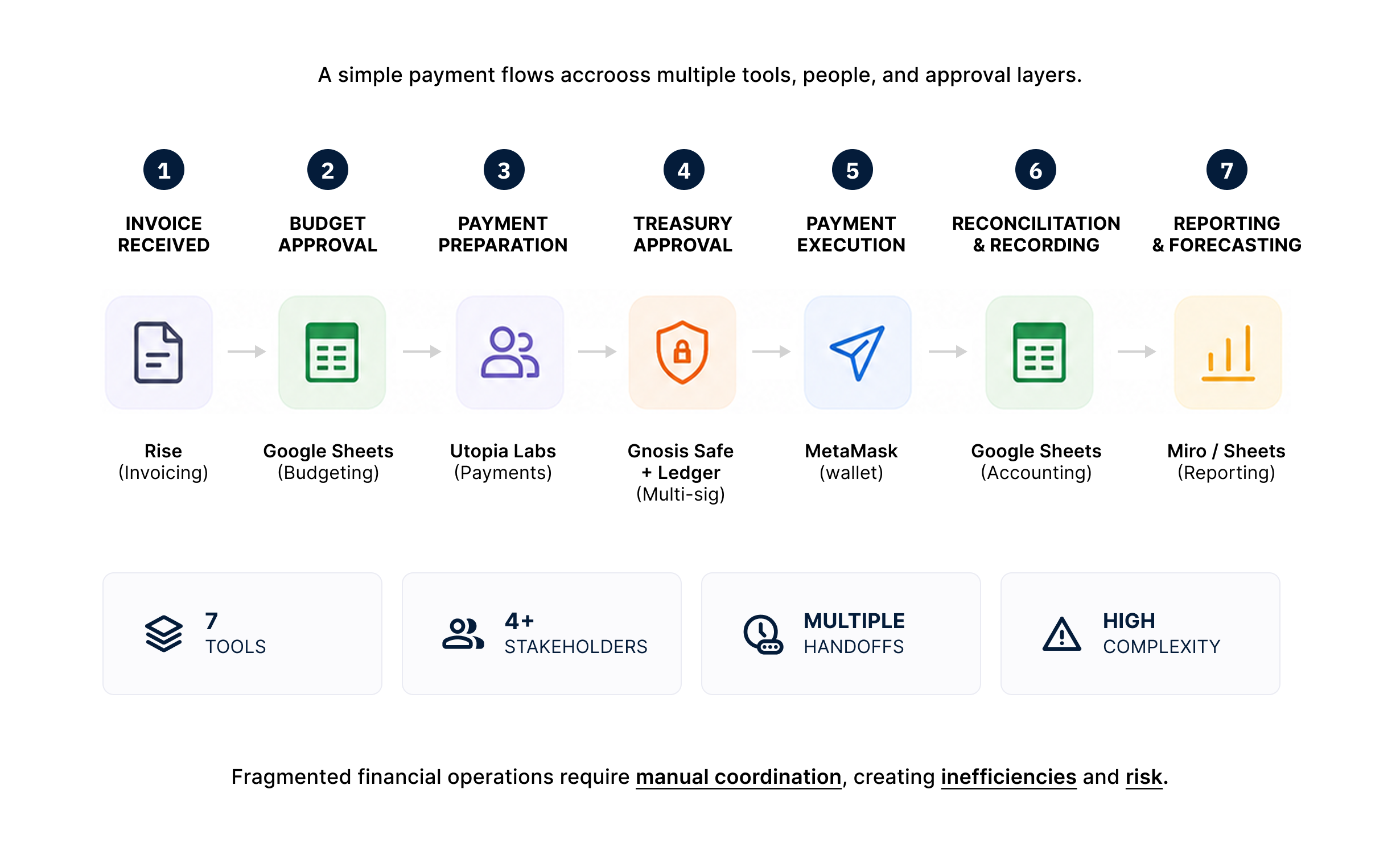
- The spreadsheet workaround: Disconnected tools forced managers to spend hours manually maintaining master spreadsheets to bridge tracking gaps.
- Operational fragmentation: Teams juggled separate platforms for asset custody, accounting, and payment requests, creating critical blind spots in daily outgoing financial pipelines.
- The custody dilemma: Users legally needed full custody of their assets, but rigid multisig wallets slowed down their daily teamwork and workflows.
The product pivot
The discovery phase validated the underlying user problem but rejected our initial standalone solution format. Interviews revealed a major trust barrier: corporate finance operators were highly anxious about migrating million dollar corporate treasuries to a brand-new, standalone startup wallet interface.
Prioritizing user feedback over a rigid roadmap, I drove a pivot from a standalone application into a flexible white-label framework. This shift allowed enterprise clients to use our secure backend infrastructure while fully customizing the interface to match their brand, compliance rules, and workflows.
Unifying Security and Usability
The product vision focused on bridging the gap between strict Web3 technical security and the collaborative multi-user UX expected from modern business software, ensuring interface patterns directly solved the functional friction identified during research.
Self-custody by default
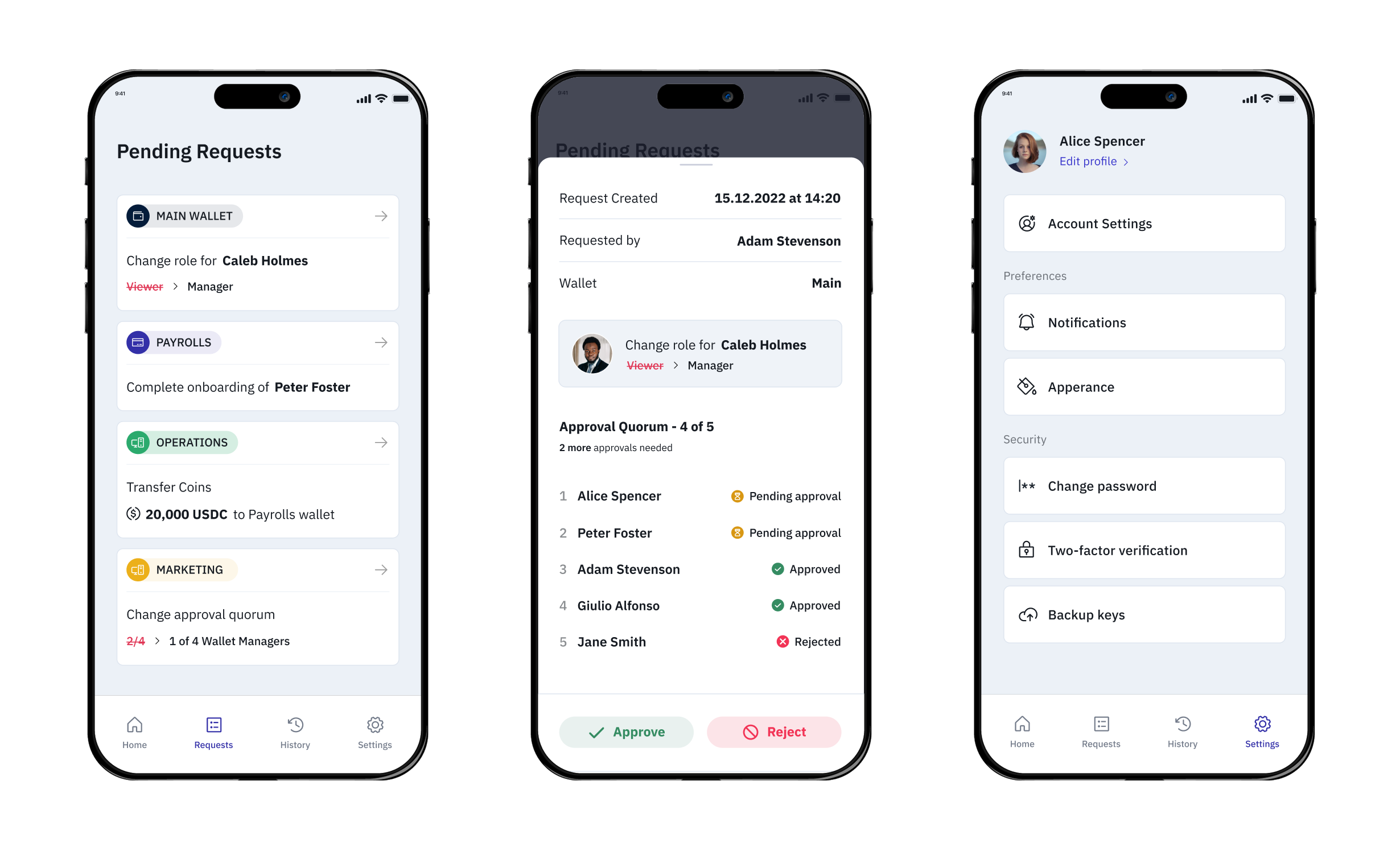
To preserve absolute asset ownership without third-party custodians, we built the UX on top of MPC and Account Abstraction. I designed step-by-step flows for distributed wallet creation, decentralized key-resharing, and secure multi-signatory wallet recovery, completely abstracting private key vulnerabilities away from the day-to-day user.
Governance & dashboard
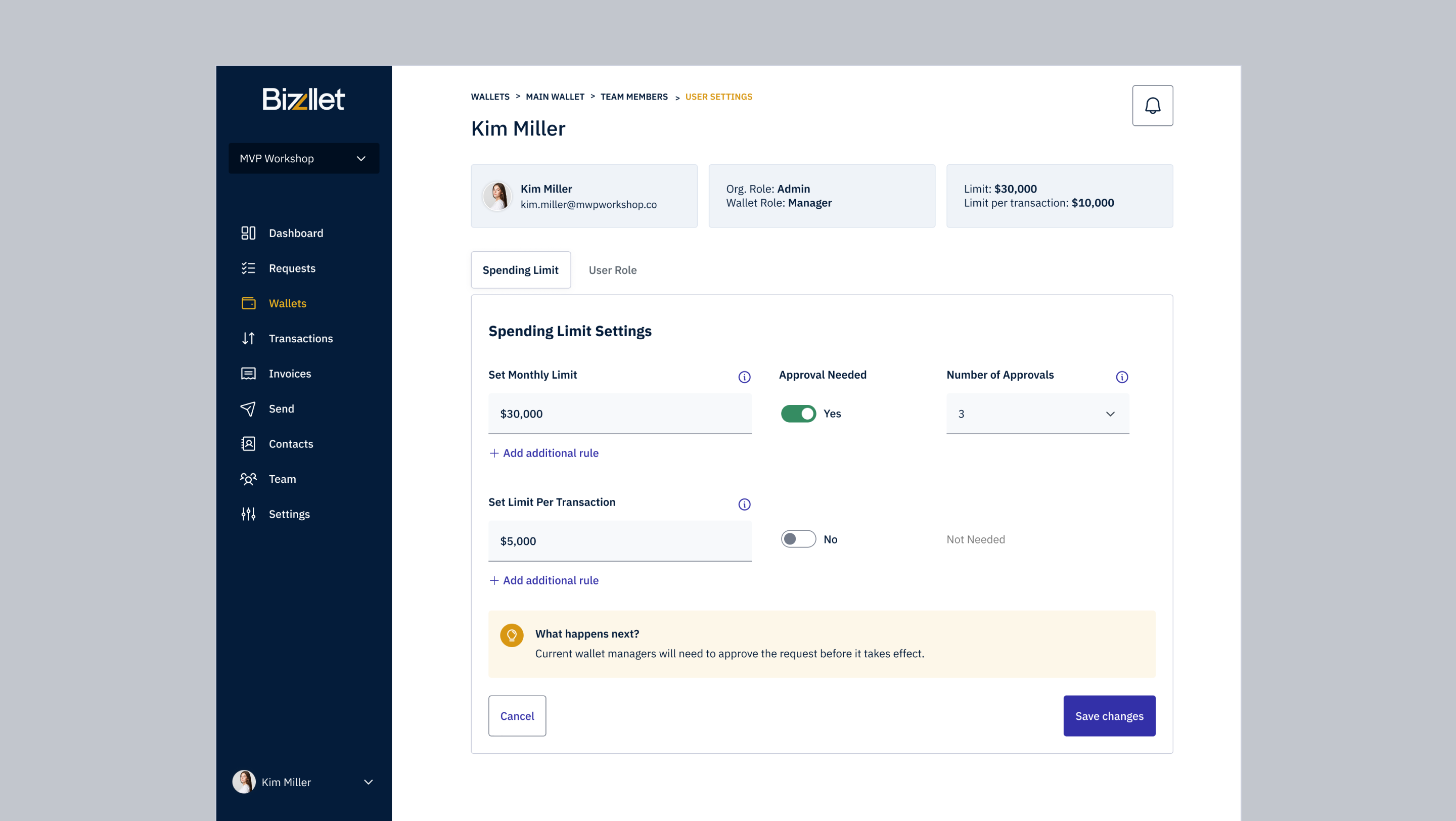
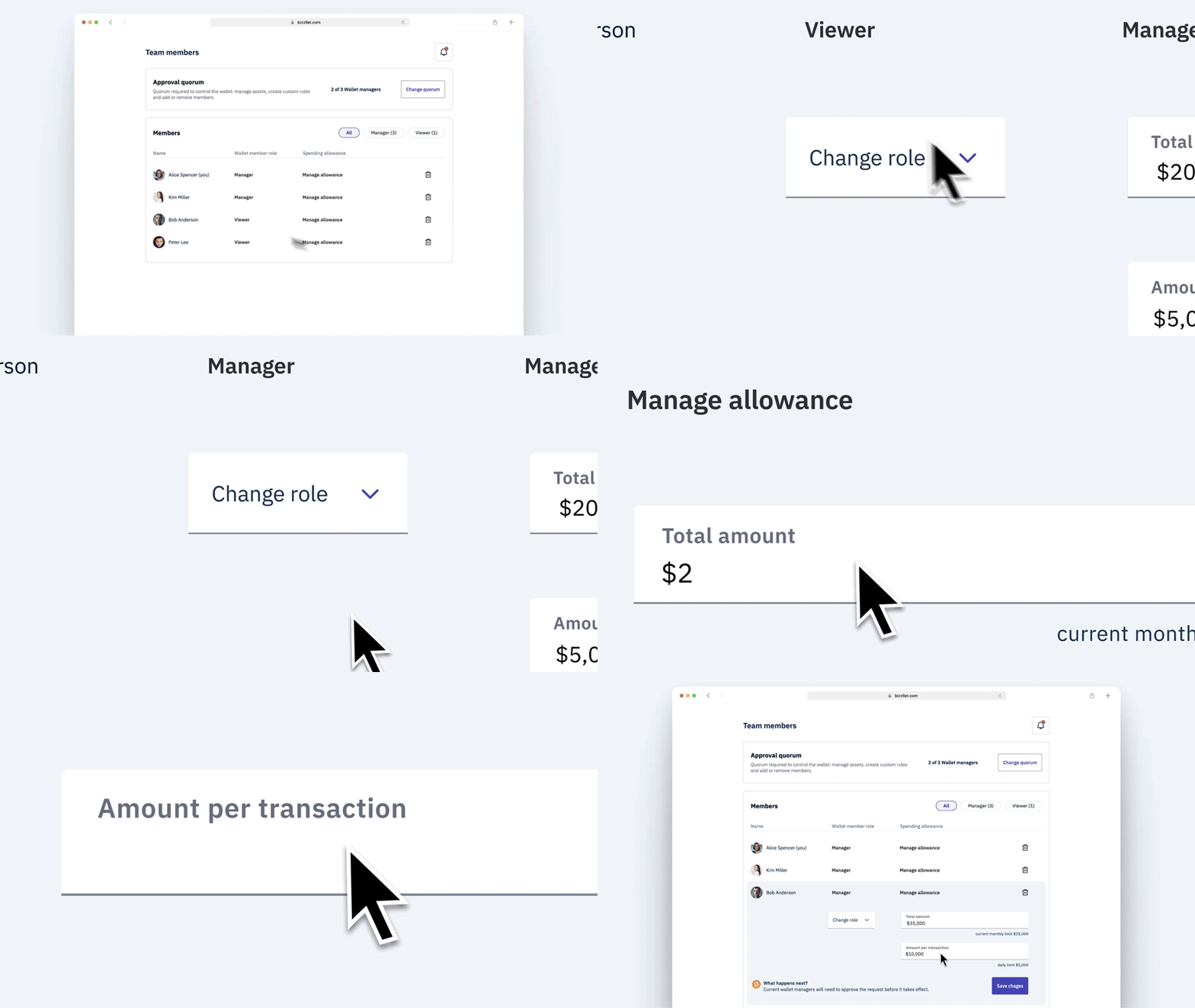
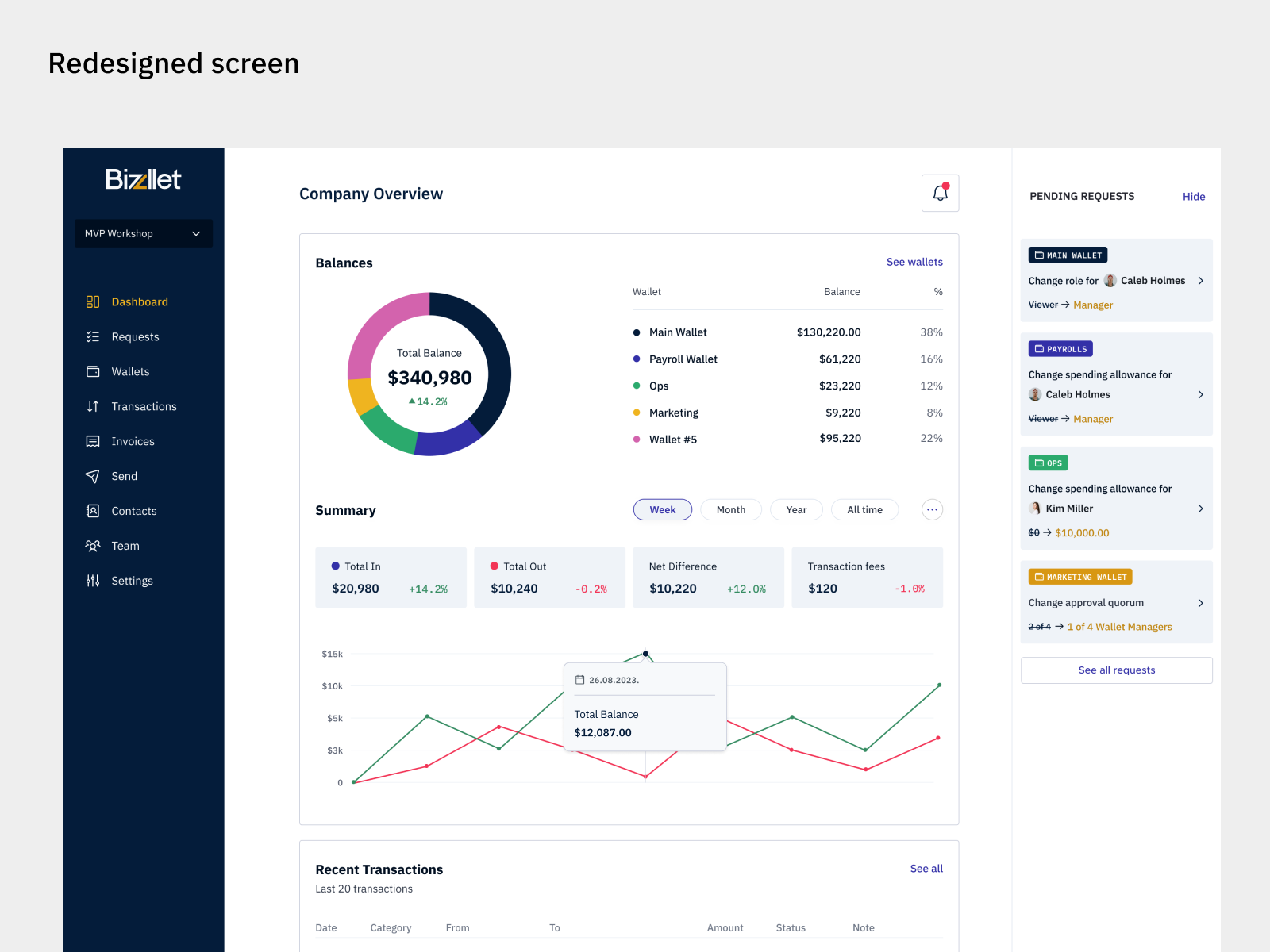
I designed an interface for granular, role-based access control, allowing finance leads to map out custom spending rules, transaction thresholds, and multi-layered approval paths—operators draft invoices, while execution power stays restricted to authorized managers.
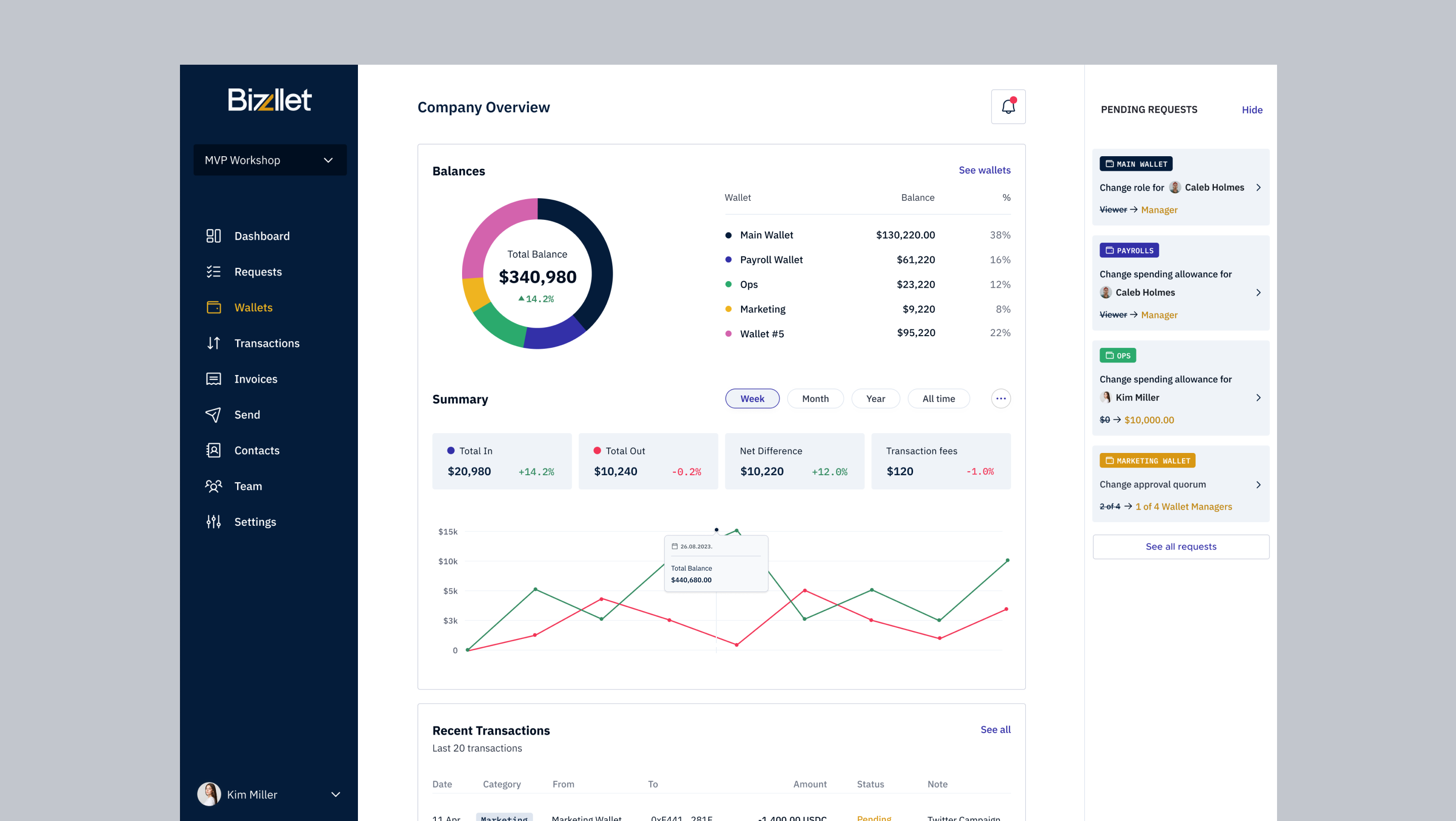
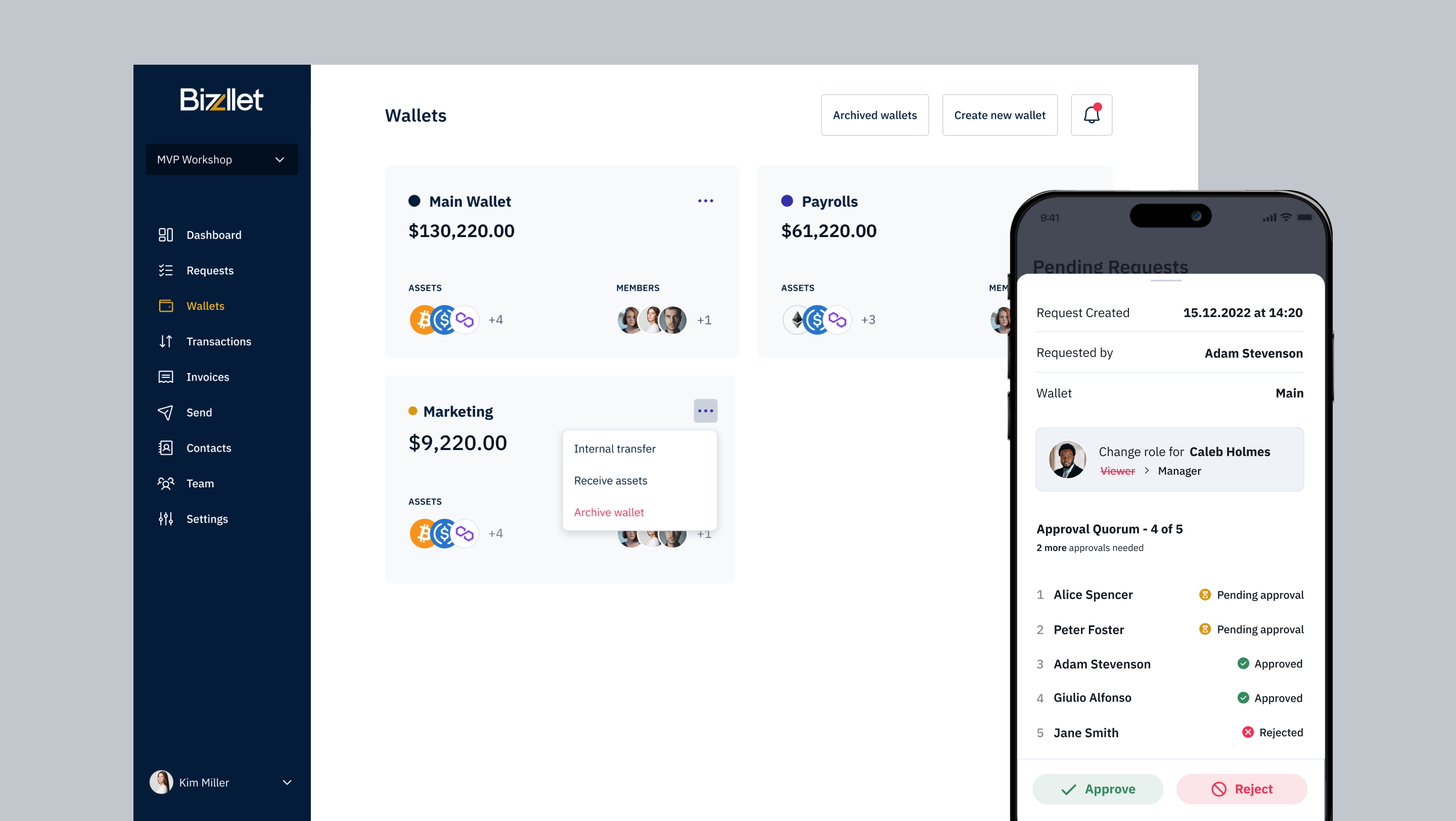
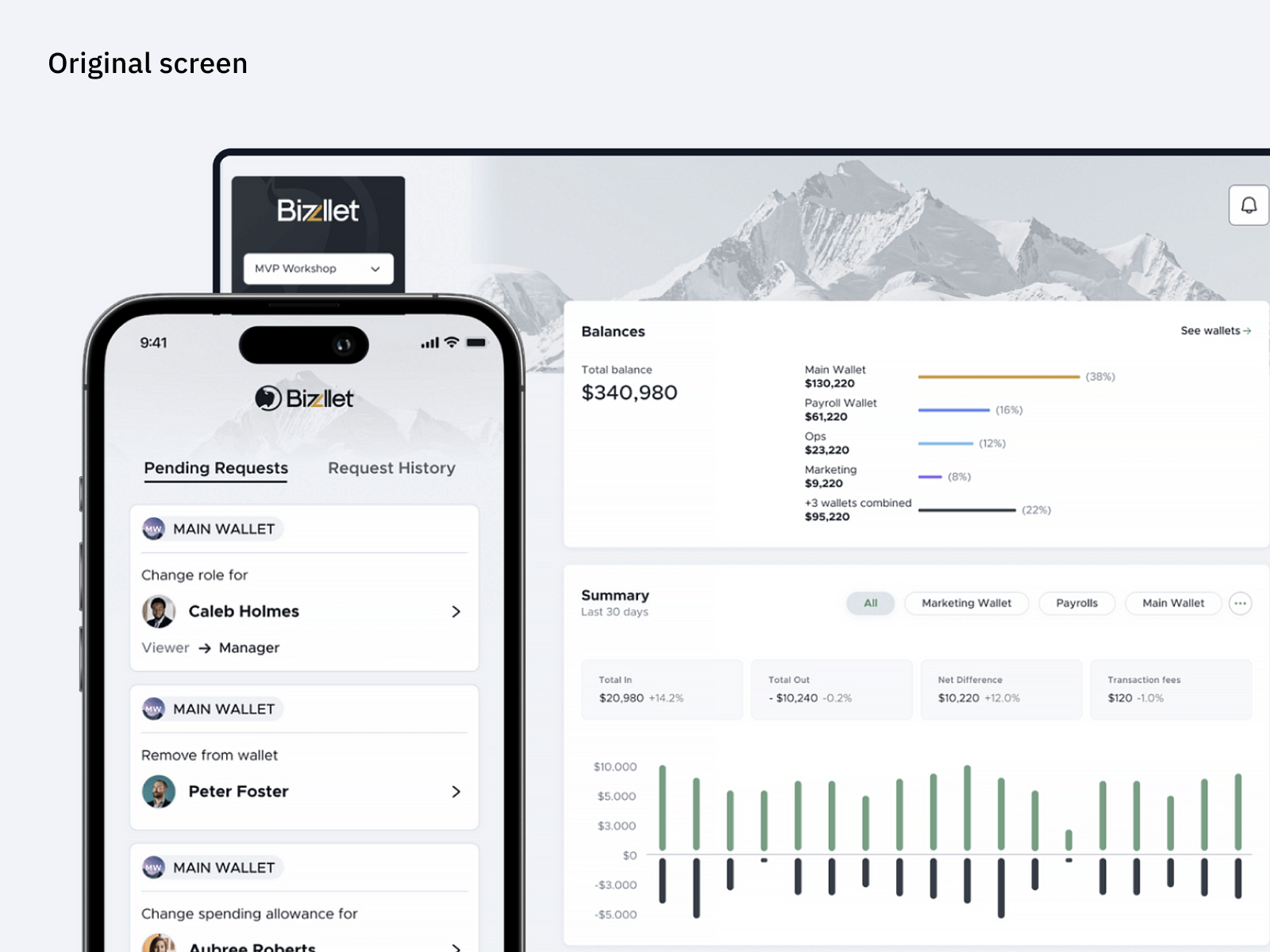
To give teams a clear overview, I designed a high-density financial dashboard that brought cross-chain balances, real-time payments, and audit logs into a single workspace.

Contextual Evolution: Corporate vs. Startup Reality
This project marked a profound shift from my early career foundation at Namics—where I built enterprise e-banking solutions for UBS within an environment defined by long timelines, strict Swiss design principles, and meticulous Frontify and Storybook documentation—to the fast-paced startup reality of Bizzllet. Moving into this lean environment forced me to trade corporate perfectionism for rapid, high-impact problem-solving, ultimately transforming my approach to design maturity through critical business realizations.
- Validation over polish: In an early-stage startup, testing core ideas quickly matters more than a perfect UI layout. Building a functional prototype to test with real users provided far more strategic value than spending weeks polishing static design systems.
- Fast decisions & iteration: Operating at high speed meant making quick design and structural choices under pressure. I learned to accept imperfect initial versions, closely monitor where users dropped off, and rapidly iterate based on direct user insights.
- Aligning design with business: Working directly with the founders showed me how design drives investor pitches and early-stage marketing. I had to constantly balance designing high-impact features to secure capital with staying flexible enough to execute major shifts—like our pivot to a white-label framework.
- Flexibility in a lean team: Being the sole designer meant doing whatever the product needed to survive. Stepping outside traditional UI/UX boundaries to help with business strategy and fill operational gaps taught me how to guide a product through market uncertainty.
Data-driven visual optimization
During visual refinement, I replaced the typeface Metropolis with IBM Plex Sans to better support a data-heavy financial environment. In an interface filled with complex wallet hashes, multi-chain balances, and dense transaction tables, IBM Plex Sans provided the geometric clarity and clean tabular numerals needed to reduce cognitive load and prevent user data-entry errors.
Direct value to future teams
Navigating tight backend constraints while maintaining a clean enterprise UX taught me how to balance technical complexity with usability. Here is what I bring to future products:
- Proactive risk identification: I actively work to discover engineering blocks, security friction, and compliance barriers early in the discovery phase before product strategy becomes rigid.
- Cross-functional collaboration: I work closely with developers and business stakeholders to ensure design decisions are technically viable, business-driven, and fully aligned with company goals.
- Designing for complex data: Proven ability to build dashboards for professional users managing high-density information, ensuring that design choices consistently support data integrity and functional clarity.